 With multiple armed conflicts serving as labs for military technology, accelerating the deployment and testing of artificial intelligence on the battlefield, how can governance keep up?
Elke Schwarz, Professor in Political Theory, Queen Mary University of London
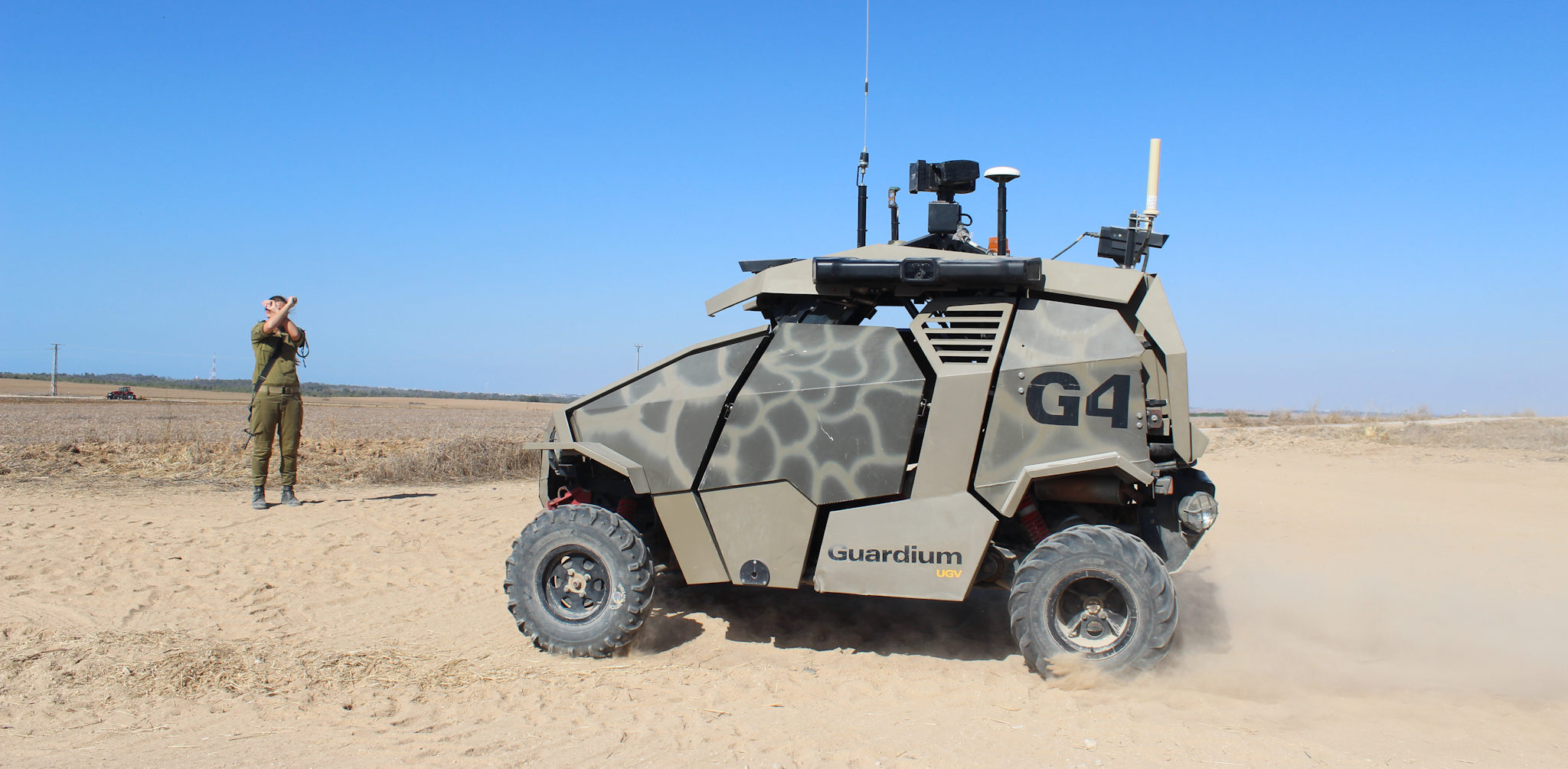
Ever since the term “artificial intelligence” was coined in 1956, AI has gradually found its way onto the battlefield. It has been used to speed up and optimize processes in areas such as supply chain management, logistics, and predictive maintenance. AI is also used for weapons, platforms and drones: making navigation more efficient, and finding ways for systems to talk to each other, and to work in swarms.
In recent years, militaries have begun using AI to speed up, scale up, accelerate and optimize targeting; that is, the application of lethal force. AI decision support systems process large amounts of data to find patterns which might indicate a legitimate target. A human operator must then decide whether the target can be taken out with lethal force, and whether this is justified. The human has less and less time to make this decision – often just seconds.
To operate well, AI systems require big, relevant, up-to-date, culturally sensitive troves of data, which are difficult to come by in conflict settings. Systems need to be updated, and to work with other systems. Often, the impetus is to get systems into the hands of fighters faster. There is an inherent risk that systems will fail, and somebody bears the cost of that failure.
In many battlefield applications, the goal is to remove human agency from certain decisions that need to be made very fast. With just seconds available, the human operator cannot possibly obtain the level of understanding which those tasked with applying lethal force usually bring to their judgments. Humans also have an automation bias, meaning we are more likely to trust a system’s output, even when it is wrong. Within a scaled-up, sped-up action loop, we tend to act, rather than taking a moment to deliberate. For ethics, that moment is really important. This double bias – towards automation and towards action – curtails our moral agency, and when moral agency is curtailed, moral restraint in the use of force is jeopardized.
When we prioritize speed, scale and optimization in the use of force, it changes our relationship to the use of force and to violence. Targets become dehumanized because everything is rendered as digitized data points, and the act of targeting becomes a simple workflow process. As data is gold, surveillance becomes normalized.
The ethical and governance challenges of systems where humans are removed from the picture – so-called autonomous weapon systems – are even higher.
With empirical evidence mounting about the problematic nature of the use of AI for targeting and autonomous weapon systems, and against the backdrop of heightening geopolitical tensions and calls to prepare for war, it is now vital that we have strict, clear and binding rules around their uses.
Here, scientists, policymakers and diplomats have an important role to play. We have the power to shape what comes next. Whatever we decide to put in place now will be very difficult to roll back. But the longer we let the accelerated rollout of autonomous systems run unchecked, the harder it will be to rein in. These systems are being driven by humans who often have a significant financial interest in their development. It is important that other humans set some boundaries.
During the Second World War, Norbert Wiener’s work on automating anti-aircraft fire laid the foundations for cybernetics — the study of communication, feedback and control in machines and living organisms. Seeing what was happening with his inventions and ideas, after Hiroshima he said he would no longer publish his work if it was going to be misused.
Today, we all have an ethical responsibility to think about the consequences of what we send out into the world. Applying some foresight, thinking through the worst that could happen, and instituting practices such as technology impact assessments will help to manage the pace of change and to defang the financiers with a vested interest in advancing unchecked.
Artificial intelligence can help us by optimizing, accelerating, making things more efficient, and scaling things up. But in parallel, humans need to strengthen our own skills, notably our ability to engage with one another, to form better civil contexts and the potential for peace. That will require being able to bear inconveniences without getting at each other’s throats because we don’t know how to resolve conflicts without force.
AI is a mathematical or computational capability, not suited to all human endeavors. It is fundamentally different from humans. And even if we have a tendency to see ourselves through the lens of our latest inventions to make sense of ourselves, we are not systems.
If we can find ways to monetize technologies for peace, or approaches to peace, and make them financially lucrative, then the future may thank us for it. I invite the GESDA community to think through how that could be done more effectively.
This article is adapted from Elke Schwarz’s remarks during AI on the Battlefield, a session at the 2026 GESDA Anticipation Summit that featured Jin Park (former South Korean Foreign Minister), Jürg Lauber (Vice-President, ICRC), and Federica Du Pasquier (Senior Advisor, GESDA). The session is available to watch below.