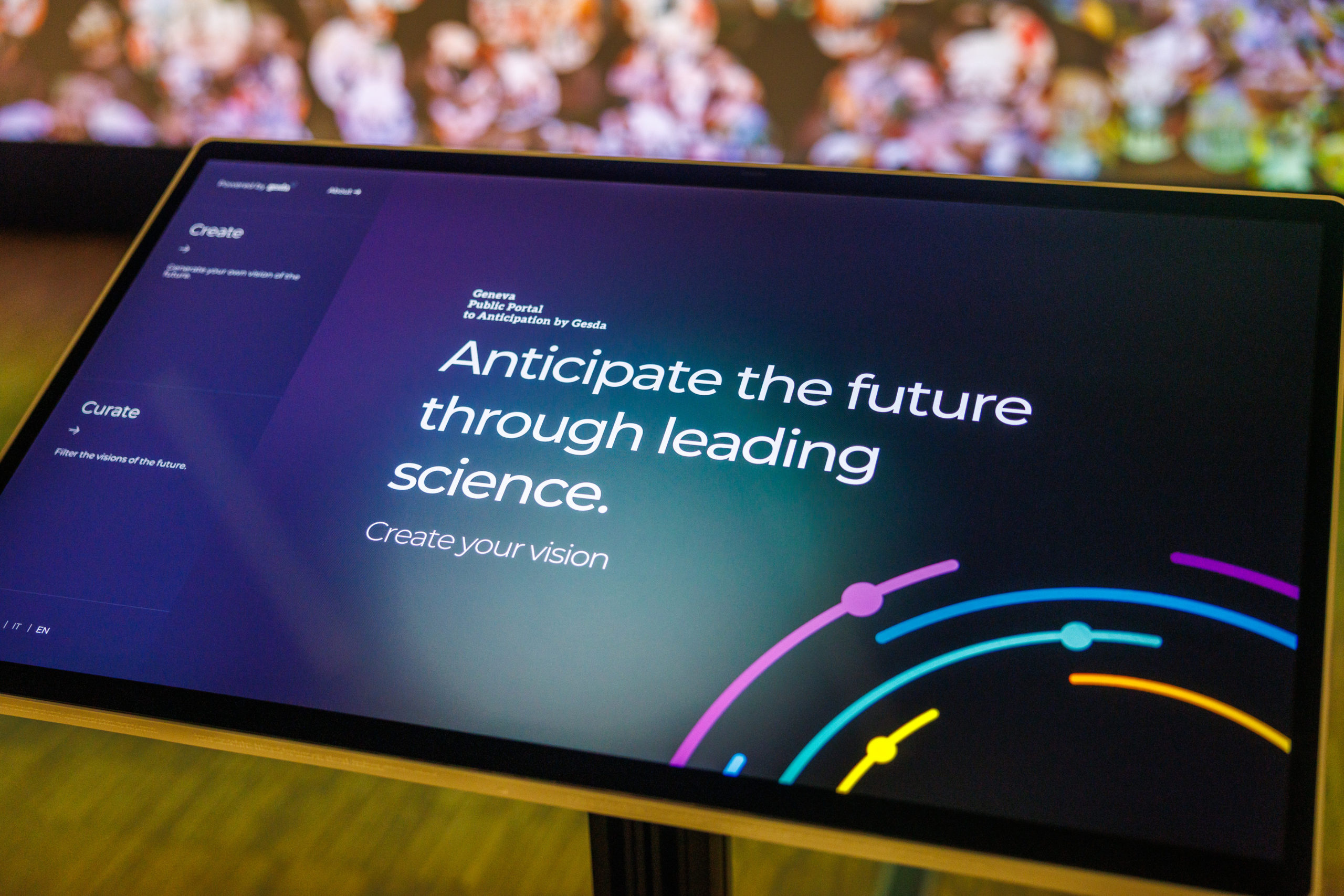
On Saturday 24 October, visitors to the Swiss Federal Palace in Bern experienced the ‘Geneva Public Portal to Anticipation’, an interactive installation developed by GESDA and EPFL which lets citizens explore how science and technology will impact society.
Fed with scientific data and powered by AI, the Portal creates a space for dialogue around emerging science and technology, allowing participants to explore the implications of anticipated breakthroughs for the economy, our institutions, the healthcare system, security, the environment, and democracy.
The Portal draws its data from the GESDA Science Breakthrough Radar, a tool which identifies expected scientific and technological breakthroughs over time horizons of 5, 10 and 25 years. First presented at the Swiss Pavilion at the 2025 World Expo in Osaka, Japan, where around 800,000 visitors engaged with the installation, the Portal was also on display at the recent 2026 GESDA Anticipation Summit in Geneva.
“Artificial intelligence, quantum computing and neurotechnologies are already reshaping life in Switzerland and beyond, and the next generation of technologies is just around the corner,” said GESDA Programme Lead, Niniane Paeffgen. “By anticipating them, we can decide how to live with them, instead of adjusting once they have arrived.”
The Portal has been created from the vision of GESDA and developed by the EPFL Laboratory for Experimental Museology (eM+), thanks to the generous support of the Ernst Göhner Foundation and the Asuera Foundation.
“The Portal gives people a way to explore emerging science through their own priorities, values and emotions, and to recognize that technological futures are not simply inevitable,” says eM+ Director, Professor Sarah Kenderdine. “Agency begins when the future stops being something simply presented to citizens, and becomes something they can interrogate.”
Thus far, public interactions with the Portal suggest a curiosity and openness to exploring scientific futures, with emotions of Surprise, Interest, Joy and Trust accounting for 69.5% of registered sentiments, compared with 28.6% for Anger, Fear and Sadness. Human Augmentation, Quantum Revolution, and Advanced AI were the most common scientific fields explored, with Healthcare and Environment the leading application domains, suggesting that participants connected scientific advances with tangible questions about human wellbeing and the planet.
You can learn more about the Portal in the video below.