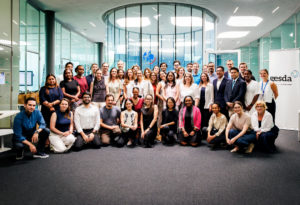

Inside Maison de la Paix, the air conditioning fought a losing battle against a packed room of leaders from science, diplomacy, government, civil society and business. Diplomats loosened ties they wouldn’t normally loosen. Scientists fanned themselves with the day’s programme. The heat outside seemed to sharpen the energy in the room, there was an edge to the conversations over coffee, a sense that the cohort had arrived at the part of the week that couldn’t be theoretical. Two days of debating where to draw the line between opportunities and risks – no matter how distant or hypothetical – had built up a kind of pressure. Today, that pressure had somewhere to go as the group turned toward a harder subject: security policy. What happens when weapons can choose their own targets, and what decisions can we take today that will determine how they’re governed?
Anticipation is not about the future, it’s about today
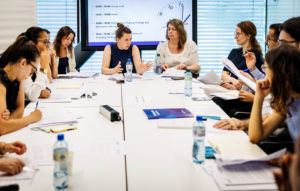
How can leaders use the future to make better decisions in the present? Emily Munro, Senior Researcher and Head of Strategic Anticipation at the Geneva Centre for Security Policy (GCSP), introduced strategic anticipation as a discipline most people misread from the start. It is not an exercise in prediction, but a mindset – a way of thinking, testing assumptions and organising action when policy choices are clouded by uncertainty.
Working first in pairs and small groups, the group experienced the discomfort of anticipation. In mixed and diverse groups, scientists sat next to diplomats, and policy officials next to NGO representatives, each debating the same hard call: imagine a new technology shows early warning signs of risk, but the evidence is still incomplete. Do you act now, or wait for more data?
A scientist in the room might want to conduct more research before raising the alarm. A diplomat might already need to brief a minister. An NGO leader might be the one pushing hardest to act now, on behalf of people who can’t wait for certainty. Putting these instincts in the same room, on the same problem, is the point: it forces a concrete answer to a question policymakers face constantly, what to do when the evidence isn’t all in yet, but a decision can’t wait.
Participants were asked to hold multiple futures in view without treating any of them as inevitable, and to see anticipation as a form of present responsibility. The session closed with one question: what would they take back to their own institutions? For many, the answer was the same, anticipation has to be both a method and a habit of leadership.
Geneva’s diplomatic DNA
At noon, the cohort gathered for a lunch discussion on the future of International Geneva with the Swiss Permanent Mission to the United Nations Office at Geneva. The discussion turned to Geneva’s own role in science diplomacy: what kind of multilateral work actually happens here, and how a city built around international cooperation responds when the system it serves comes under strain. This role, it was suggested, depends less on the number of international organizations present than on whether the institutions, missions, technical bodies and convening spaces remain relevant to the problems now arriving on the international agenda.
Geneva’s advantage, it was argued, lies in the interlinkages among organisations, technical communities and states, and in the ability to keep practical cooperation alive even when resources are tightening and political confidence in the international system is low.
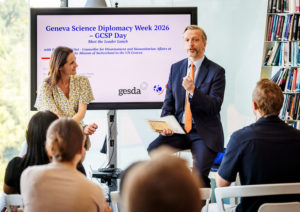
A distinction was drawn with New York: while New York is more visibly associated with high politics and security, Geneva is where the human preoccupations of the international system are concentrated: human rights, humanitarian action, refugees, health, climate, labour, technical standards and disarmament. The Human Rights Council, the UN Refugee Agency (UNHCR), the International Committee of the Red Cross (ICRC), the World Health Organisation (WHO) and the International Labour Organisation (ILO) were pointed to as part of an ecosystem whose work often becomes most visible when crises make cooperation unavoidable.
For the Science Diplomacy Week’s cohort, the lunch made Geneva’s role about human rights more concrete. Geneva is not only a diplomatic host. It is also home to ethical, technical and scientific expertise, from the UN, WHO to the ITU (International Telecommunication Union), and to a tradition of cooperation that brings governments together with industry, researchers, employers, workers and humanitarian actors.
But harder questions were also raised during the session, among them, what could participants take home to defend multilateralism when national politics increasingly questions whether international organisations still deliver. The answers pointed to the everyday work of refugee protection, migration, humanitarian action and standard-setting. The ILO’s recent convention on decent work in the platform economy, the first international labour standard for the digital economy, was offered as a concrete example: Geneva-based work that can go on to shape national legislation and the daily lives of citizens.
The exchange sharpened one of the day’s central tensions: whether the international system is too slow for the risks it is now asked to govern, or whether speed without cooperation produces weaker and less legitimate decisions. Caution was expressed regarding calls for political systems to move faster by becoming less deliberative. Democracy can be slow, it was acknowledged, but the solutions it produces are more likely to be accepted and implemented because people have had to argue them through.
The lunch also raised a question about Switzerland’s active neutrality approach. Geneva’s promise, the discussion concluded, is not that it can remove conflict from politics, it is that it can still create rooms where states, experts and institutions have to confront conflict through rules, evidence and the discipline of cooperation.
That exchange set the tone for the afternoon entering the simulation of the UN Group of Governmental Experts on LAWS (Lethal Autonomous Weapon Systems).
When weapons choose their own targets
The afternoon session carried anticipation into one of the most difficult areas of contemporary security governance: Lethal Autonomous Weapons Systems, weapons capable of selecting and engaging targets without human control.
AI-guided weapons and autonomous systems are already being used in active conflict zones, including Ukraine, Gaza and Iran, deployed years before anyone agreed on the rules for using them. The session interrogated: who decides when a machine can choose a target, and can multilateral processes even keep pace with how fast the technology is changing?
To put the learning into practice, a simulation of the GGE on LAWS reversed the roles: policymakers argued from the perspective of scientists and the technical community, while scientists stepped into the role of policymakers. Their task was to decide whether the development and deployment of lethal autonomous weapons should be banned, paused through a moratorium, or regulated — immersing the group inside the legal, technical and political constraints the other side actually faces.
The exercise also connected directly to a question that had been running through the week: when is a ban the responsible choice, and when does it simply push development out of sight? In the opening discussion on mirror biology at WHO, Gerard Escher had argued for clear, narrow red lines rather than sweeping frameworks that try to govern every future risk at once. During the second day, the debate around AlphaFold and open science had raised a similar dilemma: restricting dangerous capabilities may be necessary, but if the benefits are broad and the risks can be managed, closing everything down can also carry costs.
The LAWS simulation brought that tension into security policy. Participants had to decide whether lethal autonomous weapons should be banned, paused through a moratorium, or regulated in ways that preserve accountability while recognising that development is already underway.

Christian Sarra-Bournet, Executive Director of the Institut Quantique of Université de Sherbrooke in Canada, reflected on dual use, which is particularly important forAI in warfare. ‘Many technologies we are worried about are genuinely useful in civilian contexts: navigation, situational awareness, assessing what is happening on the ground. Think of a drone deciding how to fly through a wildfire or a flood to save lives.’ He questioned the realism of banning such weapons and retuned to the discussions on adaptive governance from the mirror biology debate. ‘If LAWS were to go underground, the case for regulation rather than a blanket ban is actually strengthened, because regulation at least ensures there is an open discussion. We don’t know where AI will end up, and as long as we have the conversation going, we can adapt.’
Federica du Pasquier, GESDA’s Senior Advisor for Governance and Prevention, led the debrief of the exercise. Geneva’s discussions on autonomous weapons started eleven years ago, but the first warning came earlier — in 2007, when the British scientist Noel Sharkey raised the alarm about ‘killer robots.’ That was anticipation in practice: scientists telling diplomats a capability was coming, and they needed to figure out what to do about it. Nearly two decades later, we have arguably got the anticipation part right. The action part is where we keep getting stuck.
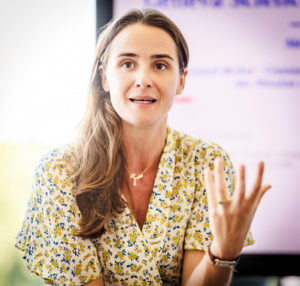
‘The premise of science anticipation is simple. If you know where science is going, you have leeway to start the conversation before positions and interests become entrenched’
A clear conclusion of the exercise was that science diplomacy training is essential on both sides. But disarmament processes have structural problems that make this hard. Decisions move by consensus, and scientific expertise is not systematically integrated — the Convention on Certain Conventional Weapons, for example, has no scientific advisory board. Smaller delegations, with less capability and scientific expertise, are particularly disadvantaged.
‘Science diplomacy cannot be reduced to scientists presenting evidence to diplomats, or diplomats managing political outcomes after the science is settled. It requires boundary spaces and professionals where technical advancements are translated into their ethical, geopolitical, human rights or security implications’, said Dr. Marga Gual Soler, programme director of the Geneva Science Diplomacy Week. ‘This is why platforms such as GESDA exist, to provide this interface.’
Candy Lindsey-Moyo, a South African diplomat and Science Diplomacy Week alumna, participated in the exercise debrief, pointing to the gap between the speed of military adoption of technology and the pace of multilateral agreement. “Technology in this space doesn’t wait for consensus,” she said. “By the time states agree on a definition, the systems being debated have often already changed.“
Profit, power and the rules of war
The day closed with Dr. Jean-Marc Rickli, Head of Global Emerging Risks at GCSP, examining how artificial intelligence is being adopted into defence and military strategy worldwide, and what it would take to capture its benefits for international security while limiting the harm. He moved the discussion from the specific case of autonomous weapons to the wider militarisation of emerging technologies such as neurotechnology, synthethic biology or mirror biology, as explored earlier in the week.
For example, the convergence of synthetic biology and AI, with its dual-use potential capable of accelerating vaccines and therapies while also lowering the barriers to the design and development of biological weapons, The question of moratoria came back: if it’s impossible to control proliferation of dual-use technology, is it better to regulate it, to avoid bad actors going underground?
Advanced AI is increasingly a force multiplier, not only in conflict, but in diplomacy, information environments and strategic competition. Rickli pointed to drones as the clearest example: systems that moved in roughly ten years from large, pilot-operated platforms to small devices flying in coordinated swarms, with autonomy increasing and human control over individual decisions decreasing at every step. “Every major military power is racing to integrate AI,” Rickli said, “and very few are racing equally hard to govern it.”
The day moved the cohort from learning security policy to testing it against LAWS. The morning offered a method for handling uncertainty. The afternoon delivered the real thing: autonomous weapons already deployed in active conflict, a decade-old negotiation still stuck on basic definitions.
The sun was finally setting on another scorching Geneva day. Tomorrow, the cohort picks the discipline back up on new ground: quantum computing at CERN. Will this cool our minds?
Stay tuned!