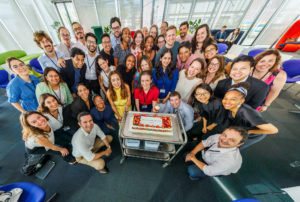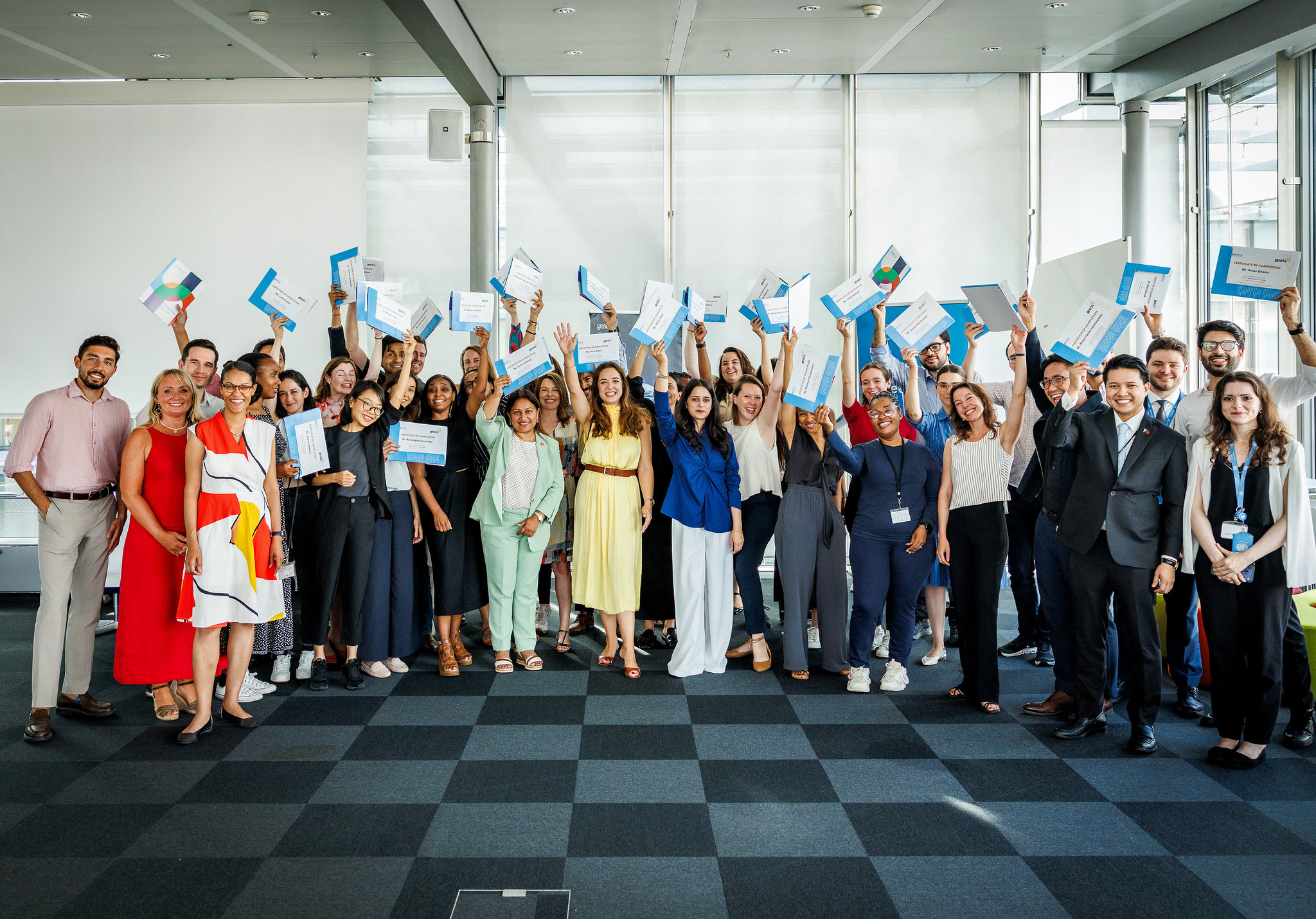

The cohort closed Geneva Science Diplomacy Week at Campus Biotech, GESDA’s home. Five days earlier, they had arrived as strangers from different fields and different governments. By the programme close, they had become part of the same community of GESDA ambassadors, carrying five days of shared thinking and shared experience with them. Again and again, they found that the challenges they each deal with are the same ones, just dressed in the context of wherever they happen to work. The day’s topic put that to the test one final time, on two things nobody owns outright: the orbits above us, and the ice at the poles.
No treaty since 1979
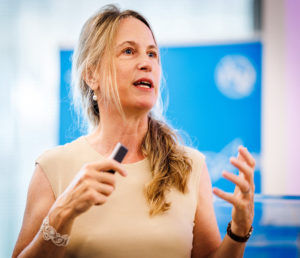
Daria Robinson, Executive Director for Multilateralism and Communities at GESDA, opened the morning with the numbers behind the urgency. A decade ago, roughly 1,200 satellites orbited Earth; today there are close to 3,000, with more than 28,000 tracked pieces of debris and over 70 nations now active in orbit, up from 25 a decade ago. The legal architecture meant to govern all of it hasn’t kept pace: no binding multilateral space treaty has been added since 1979, and even that one was never ratified by a single spacefaring nation.
In that time, private companies have gone from absent to dominant. They launch tourists into orbit, fly intelligence and surveillance satellites once reserved for governments, and operate hardware that can just as easily disable a rival’s spacecraft as repair their own. The law never saw any of it coming. No one is liable for damage a private satellite causes in orbit, only the state that launched it, and nothing requires debris removal or collision coordination.

Working in small groups, the cohort spent the morning proposing fixes. One group borrowed an idea from Singapore’s car-ownership system: cap how many satellites an orbit can hold, and retire old ones before new ones launch. Another suggested governing space the way CERN governs particle physics, as shared infrastructure that no single country owns, but every country can join and benefit from. Others proposed an international insurance fund to make orbital recklessness expensive enough to police itself, and an ICAO-style traffic authority for space. Underneath all of it ran the same complaint: countries without the money to reach orbit have no voice in writing its rules.
When the groups reported back, Dr Natália Archinard offered the long view. She has spent decades working on space policy, first at Switzerland’s Federal Department of Foreign Affairs and now as Senior Advisor on Outer Space at the Centre for Humanitarian Dialogue, with years inside the UN Committee on the Peaceful Uses of Outer Space along the way. Her diagnosis: every new rule needs every member state to agree, and the agency meant to oversee it all runs on a staff of roughly 25 people.
Asked what stops today’s powers from cooperating the way the US and Soviet Union did even at the height of the Cold War, she pointed to something missing: a shared project concrete enough that rivals need each other to make it work, the way astronauts in orbit depend on one another, regardless of who sent them up. For companies, the incentive is simpler. An operator who doesn’t know where a rival’s satellite is sits one collision away from losing its own.
The ice has no constituency

In the afternoon, Dr Mira Wolf-Bauwens, Head of Initiatives Development at GESDA, opened with a scenario instead of a slide: a coalition wants to pump seawater onto Arctic sea ice through the winter so it freezes thick enough to survive the summer melt. The science is plausible. Funding is starting to appear. No nation owns the ice, no one living there can be consulted, and yet it regulates sea level and monsoon rainfall for everyone on the planet. Would you intervene, hold back, or wait for more information, knowing that waiting is itself a choice with consequences?
Her argument: “ethics isn’t a brake diplomats apply to slow science down. It’s the discipline that helps them navigate conflicts science can’t resolve on its own.“ She named three ways ethics gets hollowed out until it stops working. As compliance, it becomes a checklist that says what’s permitted, never what’s right. As a metric, it hides a political choice behind a number. As private virtue, good intentions replace an argument anyone else can actually hold you to. “The cleaner the metric looks, the more politics is hidden,” she said. Her advice: “whenever a problem arrives dressed as purely technical, ask whose interest is riding inside that “neutral” framing.“
The cryosphere, Earth’s frozen world of sea ice, glaciers, ice sheets and permafrost, is the first real-world testing ground for this kind of dilemma. Almost nobody lives there, yet it quietly regulates sea level and rainfall for everyone else on the planet, which is exactly why it raises every hard question at once.
Four tensions kept coming up.
- There’s moral hazard, the risk that simply having a fix on the table makes it easier to keep avoiding the harder work of cutting emissions.
- There’s irreversibility: you can’t test something like refreezing the Arctic on a small scale first, so once you act, there’s no undoing it, and that means even choosing to do nothing becomes a choice with lasting consequences.
- There’s justice across time and across species, since the people most affected by what happens to the ice haven’t been born yet, live far away, or aren’t human at all.
- And there’s legitimacy without a constituency, the simple fact that no government can really claim to speak for a place where nobody lives.
In a closing exercise, each participant took on a single stakeholder and had to argue, in one sentence, what that voice would demand. There was a low-lying island state pleading for its own survival, an Arctic Indigenous community speaking for a homeland already changing beneath them, a future generation that doesn’t yet have a voice of its own, the company holding the patent on the very technology being debated, and the ice system itself, asked to speak for something that cannot speak.
The point was never to settle the argument between them. It was that none of those demands is wrong, and that the diplomat’s job is to hold the tensions open long enough that whatever gets decided is something even the side that lost the argument can recognise as fair.
From Card Games to Kizuki
The Geneva Science Diplomacy week closed with the Future World Serious Game, a simulation built around the UN’s 2030 Sustainable Development Goals and facilitated by Alice Richard. Developed in Japan and played by hundreds of thousands of people worldwide, the game hands each team a budget of time and money and asks them to run their own projects, without ever knowing how the choices of every other team in the room will land on the world they all share. Teams traded projects with real economic, environmental and social trade-offs, watched the results play out on a fictional World Condition Meter, then pushed further toward 2040 as the consequences of the first round became impossible to ignore. The bargaining got loud, leverage was offered, principles were tested, and alliances were rebuilt in real time.
What the game is actually designed to produce isn’t a winning strategy, but what its Japanese creators call a kizuki, a personal moment of realization that can’t be explained to you in advance, only arrived at on your own, usually the instant you notice how your own choices just reshaped a world you thought you were building alone.
One programme to celebrate 5 years of success
A hot and energetic week came to a close with the celebration of Geneva Science Diplomacy Week, the fifth cohort of GESDA’s flagship programme, marked with certificates and a cake cut for five years of the programme. In the closing debrief, the impact already showed up as action rather than reflection.
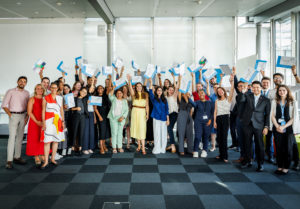
Brian Poe Llamanzares, the congressman of the Philippine House of Representatives of the Geneva Science and Diplomacy week learners, said his team had filed two pieces of legislation that same day: a bill to create an AI ethics board, an idea sparked by the week’s neurotechnology session, and a resolution calling for a science day in Congress, where scientists would brief lawmakers directly on what they need. Xiaoyu Fang, who works on marine and coastal sustainability, said she planned to connect the cohort with Future Earth, a network of more than 27 research organisations, and pointed to a stalled Japanese government plan for a national science policy hub that she expects to restart soon. And Lena Castro Castro, new to science diplomacy, said the week had given her the motivation to carry these ideas back into her own organisation, despite the full inbox waiting for her at home.
The cohort integrated seamlessly into GESDA’s community of ambassadors, adding a fresh set of brilliant minds to the network, leaders whose outlook had shifted and whose anticipatory leadership had sharpened over five days. They left carrying the same mission forward: using the future to build the present.