Brain decoders produce interpretations of our inner speech, not recordings. As policymakers turn their attention to legal safeguards of neurotechnology, experts say the dystopian vision of widespread mind-reading remains out of reach for the foreseeable future.
Imagine a world without murder. In Steven Spielberg’s Minority Report (2002), a specialised police unit prevents homicide by extracting visions of future crimes from psychics, projecting them onto screens as video sequences, and arresting suspects before their intent to murder is realised. Or consider the Black Mirror episode “Crocodile” (2017), in which investigators download memories directly from a person’s brain, turning their inner life into courtroom evidence.
For decades, such scenarios belonged to the realm of fantasy. The human brain, hidden within the skull and long regarded as the sanctum of private thought, remained largely inaccessible to scientific inquiry. That situation has changed. Thanks to rapid advances in neurotechnology combined with generative AI, we are increasingly gaining access to the previously hidden landscape of mental life.
The implications are both exciting and deeply unsettling. “We have to be concerned about how this technology will be used,” says Rafael Yuste, a neuroscientist at Columbia University and a leading advocate for the protection of neural data. “If it’s used to restore communication to patients with paralysis or ALS, that’s great. But if it’s used in courtrooms, in interrogation settings, or by tech companies to commodify mental data, we should be very concerned.”
Therefore, for policymakers and the public, the question is no longer whether “mind-reading” technologies are possible but what exactly they can – and cannot – do.
How does brain-reading work?
In essence, mind-reading in popular culture refers to decoding patterns of neural activity to infer what a person is seeing, hearing or thinking. Typically, volunteers are exposed to specific stimuli, such as images or spoken words, while their brain activity is recorded. These data are then used to train AI models to learn the relationship between neural patterns and external stimuli. Once trained, the model can work in reverse: by analysing brain activity, it can predict, with varying degrees of accuracy, what someone is seeing, thinking or even dreaming.
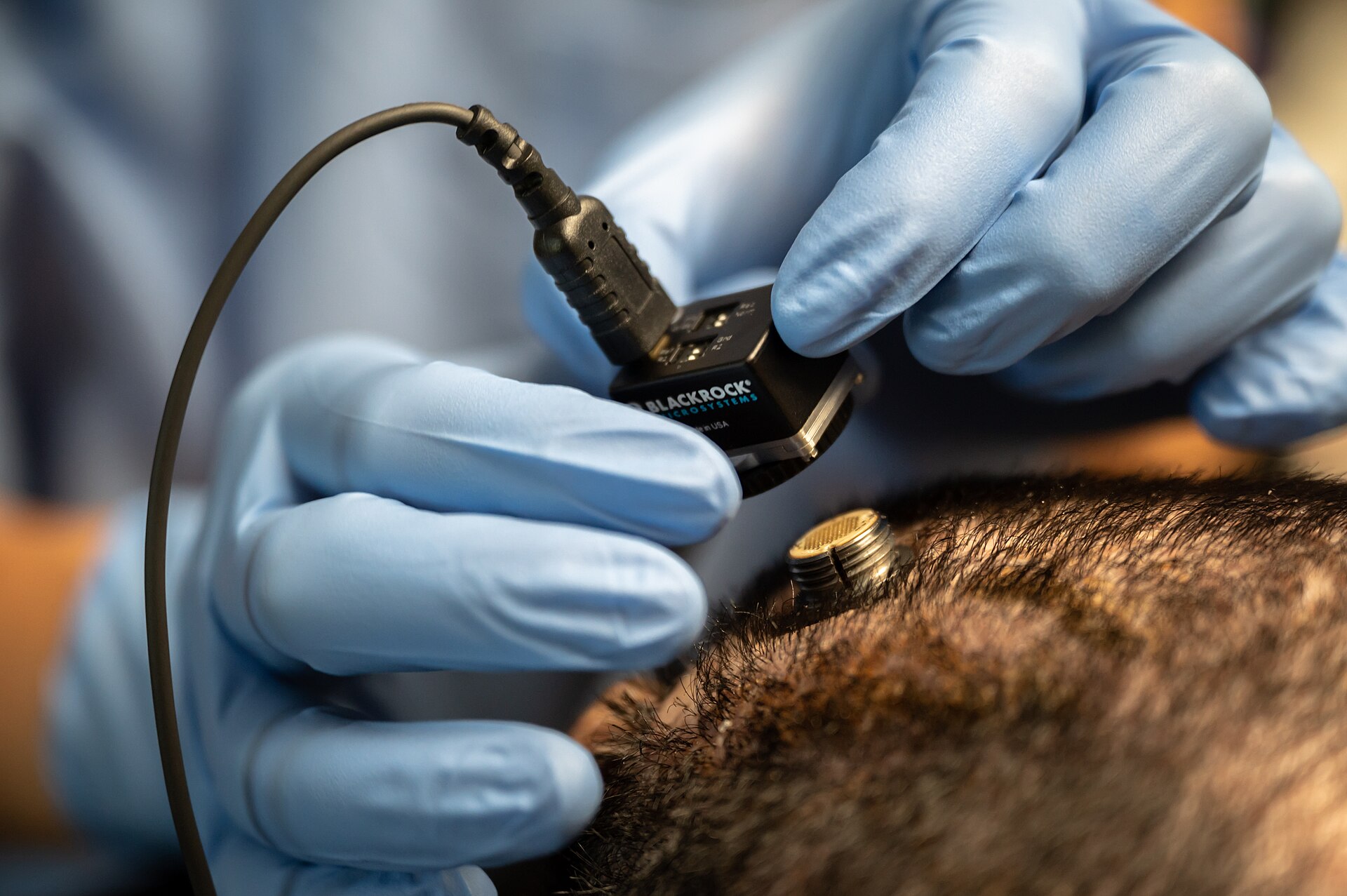
“It’s important to distinguish between two categories of neurotechnology,” Yuste explains. On one end are invasive devices such as implanted intracortical electrodes, which record activity directly from the brain; on the other are non-invasive tools such as functional magnetic resonance imaging (fMRI) or electroencephalography (EEG), including wearable devices now being marketed directly to consumers. “Invasive systems can measure and decode brain signals with far greater precision,” Yuste notes. “Non-invasive wearables provide much less detailed data.”
Public discourse often swings between exaggerated hopes and dystopian fears. “These technologies have sparked intense debate about privacy issues,” says Anna Wexler, a neuroethicist at the University of Pennsylvania. “People are asking: will Big Tech read my thoughts? Are my daydreams safe?”
Decoding thoughts and language
To assess such concerns, it is helpful to consider the areas that have captured the public imagination. We can look, for example, at one of the most promising applications of this technology – restoring communication to people who have lost the ability to speak. In a landmark 2023 study, researchers enabled a woman paralysed by a stroke to communicate via a digital avatar. By placing electrodes in the speech-production areas of her brain, the system decoded her neural signals into full sentences and facial expressions, allowing her to interact with her family.
“We can now decode about 60 to 80 words per minute,” says Jaimie Henderson, professor of neurosurgery at Stanford University. That’s about half the speed of natural human speech. “But it’s not just about speed; accuracy remains a key challenge.” While Henderson anticipates that future technologies will provide richer information, he points to a fundamental anatomical obstacle. “Much of the information-rich tissue is buried within the folds of the brain and is inaccessible to the current generation of electrodes.”
To bypass these physical limits, researchers are shifting focus from decoding signals from language areas to decoding the more abstract realm of semantics, which is processed by distributed networks across the brain. Using non-invasive fMRI, teams have begun to translate the mind’s inner workings into a form that can be used to communicate with the outside world. Last year, researchers were able to decode non-linguistic brain activity into descriptive sentences of what a person was seeing or thinking. This has sparked ethical concerns, such as the risk of unintentionally revealing primitive thoughts before individuals have chosen to verbalise them.
This work also raises profound questions about the very nature of thought. “The question of how language and thought relate to each other opens up a whole philosophical discussion that lies at the root of whether we will ever be able to read minds,” says Henderson. “We have to define what that actually means. If we mean being able to detect a brain-wide state that gives us some idea about what a person is trying to communicate without them having to articulate it, then we can already do that to some extent. But when it comes to truly abstract concepts, it becomes difficult. Because where is the boundary between what is and isn’t represented by language?”
Decoding visuals
Imagine waking up in the morning and being able to play back your dreams like a video. Current approaches rely on visual decoding. During sleep, researchers record brain activity. Upon waking, participants report the imagery from their dreams. Machine learning models are then trained to associate reported categories – such as “building” or “person” – with the recorded patterns.
While the results are intriguing, they are extremely modest and far from a cinematic vision. With continued improvement of AI algorithms and a deeper understanding of how the brain encodes information, it is likely that we will be able to visualise our dreams in much greater detail in the future. However, dreams are emotionally charged, symbolic stories rooted in personal memories and meanings, all of which arise from complex interactions between distributed networks. Therefore, experts believe that true “dream decoding” is beyond our current scientific grasp.
Decoding lies
The idea of a perfect lie detector is another powerful draw. Some researchers have explored whether fMRI can distinguish truthful responses from deceptive ones by identifying increased activity in brain regions associated with cognitive control and inhibition.
While certain brain patterns are associated with lying under laboratory conditions, lie detection remains unreliable in practise. Lies do not have a unique neural signature. The cognitive processes involved vary depending on context and emotional involvement and can also occur when telling the truth under pressure. Furthermore, memories are not stored like documents in a folder. They are reconstructed each time they are recalled. As one expert notes, “people who lie most effectively actually believe their own lies.”
Limits to mind-reading: an interpretation, not a recording
Beyond the specific challenges in each of these examples, fundamental features of both the technology and the brain itself suggest limits to mind-reading. First, neurotechnology does not actually “extract” an image, a memory or any other piece of information from our brains, as suggested in Minority Report and Black Mirror. Instead, AI produces probabilistic approximations based on the closest match from the dataset it was trained on. The output is an interpretation not a recording.
Second, neural representations are highly individual. A model trained on one person’s brain activity generally cannot transfer reliably to another. “The representation with any two persons is never going to be exactly the same,” says Henderson. “This is because we all have our own physical, mental, visual, auditory and emotional experiences. Each person builds their own brain.”
Finally, practical constraints limit invasive measurements. High-resolution decoding requires electrodes to be surgically implanted, a procedure that is ethically unacceptable for widespread use in healthy individuals. Non-invasive methods like fMRI require cooperative volunteers to lie still for hours in a scanner to create the datasets. In short, the dystopian vision of widespread mind-reading is technologically implausible in the near future.
Could this change with the rapid advancement of non-invasive wearable consumer devices such as EEG-equipped helmets and headbands? These devices measure electrical activity detectable in the scalp and can already reveal brain states such as alertness, focus, fatigue and anxiety. Major tech companies are entering this market, envisioning thought-to-text communication via wearable devices such as earbuds. “They foresee a future where you can send a text message just using your thoughts,” says Yuste. The question remains whether these devices could reveal our private thoughts in the near future.
“The signals that you pick up at the surface of the scalp are not from individual neurons,” says Henderson. “They are filtered through the skull, the scalp and the intervening tissues and are by necessity a lower-definition version of what’s happening in the brain. Will they ever approach the spatial resolution of a surgically implanted system? Unless new physics are invented, I can’t see that happening.”
The advances in technology and machine learning are truly striking. “But we must be careful that the hype does not outpace our neuroscientific understanding,” cautions Henderson. “We still have a very limited understanding of how concepts and language are represented in the brain.” Thoughts are encoded across networks of billions of neurons and embedded in broader cognitive and emotional contexts that are continuously being reshaped.
“I think there is a lot of untapped potential and a lot of unexplored territory,” says Henderson. Nevertheless, he believes that mind-reading will reach a limit. “If the brain were simple enough for us to understand it, we would be too simple to do so. This suggests that sufficiently sophisticated representational systems may face fundamental limits in fully representing themselves.”
So, will we ever be able to read people’s minds? “The answer depends on what you mean by ‘reading’,” says Marcello Ienca, a neuroethicist at the Technical University of Munich. “If you mean direct access to thought, then the answer, in my view, is no. I think this is way beyond the reach of modern neuroscience and artificial intelligence.” Ienca offers a compelling analogy. When we read a book, we perform a translational process through which ink marks on a page are converted into meaning via our language competence and shared conventions. Similarly, neuroscience interprets signals with the help of AI models. “If by reading we mean the conversion of signals into meaning,” Ienca says, “then what current neuroscience can do is a form of mind-reading.”
The popular imagination often overstates what is possible. Predicting crimes from thoughts, decoding dreams like high-definition films, and exposing lies with certainty are all scenarios that rest on simplified assumptions about how the brain stores and represents information. “We are in a very frothy time for brain technologies,” says Henderson. The gap between pop-culture fantasy and the real world of the laboratory is immense.
Yet this gap is not without value. “Science fiction generates a lot of hype,” says Wexler. “But viewed positively, it does important work. It’s difficult to imagine what society might look like in the future. Science fiction helps us to envision how new technologies could reshape society. In ethics, we deal with similar questions – how to practise anticipatory ethics and how to engage in responsible futurism. This is not trivial. In this respect, science fiction can be useful.” It forces us to grapple with profound questions today so that we are better prepared for tomorrow’s reality.
By
Theres Lüthi, science journalist
Featuring
Jaimie Henderson, professor of neurosurgery at Stanford University (USA)
Marcello Ienca, neuroethicist at the Technical University of Munich (Germany)
Anna Wexler, neuroethicist at the University of Pennsylvania (USA)
Rafael Yuste, neuroscientist at Columbia University (USA)