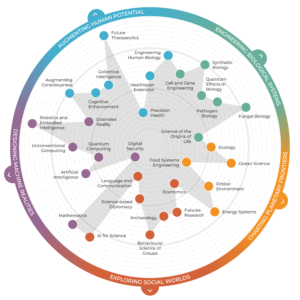
New insight from the Geneva Science and Diplomacy Anticipator (GESDA) reveals that the areas of scientific research in most need of early preparedness, because of their likely transformative impact on society, are robotics & embodied intelligence, therapeutics, mathematics, fungal biology, and artificial intelligence.
GESDA’s Science Breakthrough Radar maps anticipated research trends and breakthroughs over the next 5, 10 and 25 years directly with scientists, with the aim of helping nations and institutions prepare in advance for what the future holds, rather than reacting to the impact of breakthroughs. The Radar’s latest findings highlight the impactful potential of five fields in particular:
- Robotics & Embodied Intelligence – as AI leaves our screens to inhabit machines, it will automate dull, dirty and dangerous jobs, and enable exciting new use cases.
- Future Therapeutics – advances in targeted gene therapies and immune “hacking” could bring breakthroughs in the treatment of cancer, viral infections, and autoimmune diseases.
- Mathematics – will help us understand human-climate feedbacks and speed up progress in biology and medicine.
- Fungal Biology – enzymes promise breakthroughs in greener biofuels, waste-water treatment, and anti-ageing drugs.
- Artificial Intelligence – AI will speed up scientific research and conduct experiments, shifting the role of humans toward framing problems.
Insights from the Science Breakthrough Radar are being discussed, together with their potential implications, at the 2026 GESDA Anticipation Summit, taking place in Geneva on 14 and 15 October, and attended by 900 representatives from government, international organisations, science and industry.
“By anticipating which future scientific and technological advances will have a significant impact on life on earth, we generate intelligence for informed discussion, concerted decision, and consequential action,” says GESDA Director General, Prof. Marilyne Andersen.
“Anticipation is only useful if we can act on it,” says GESDA Chairman, Peter Brabeck-Letmathe. “Our Radar shows where science is heading, but the GESDA Anticipation Summit is where governments, researchers and industry can debate its implications for society, before the next breakthrough forces their hand.”
 GESDA recently convened a high-level review chaired by Stephen Toope, President and CEO of the Canadian Institute for Advanced Research, to assess what the Radar has achieved. In parallel, a body of scientific experts appraised the Radar’s initial anticipations from 2021, concluding that they had reliably charted the direction of science.
The Radar anticipated, for instance, that organ rejuvenation therapies would emerge within five years in animals, as well as major advances in quantum computing and the rise of transient genetic reprogramming.
The Science Breakthrough Radar is available to consult on the GESDA website.