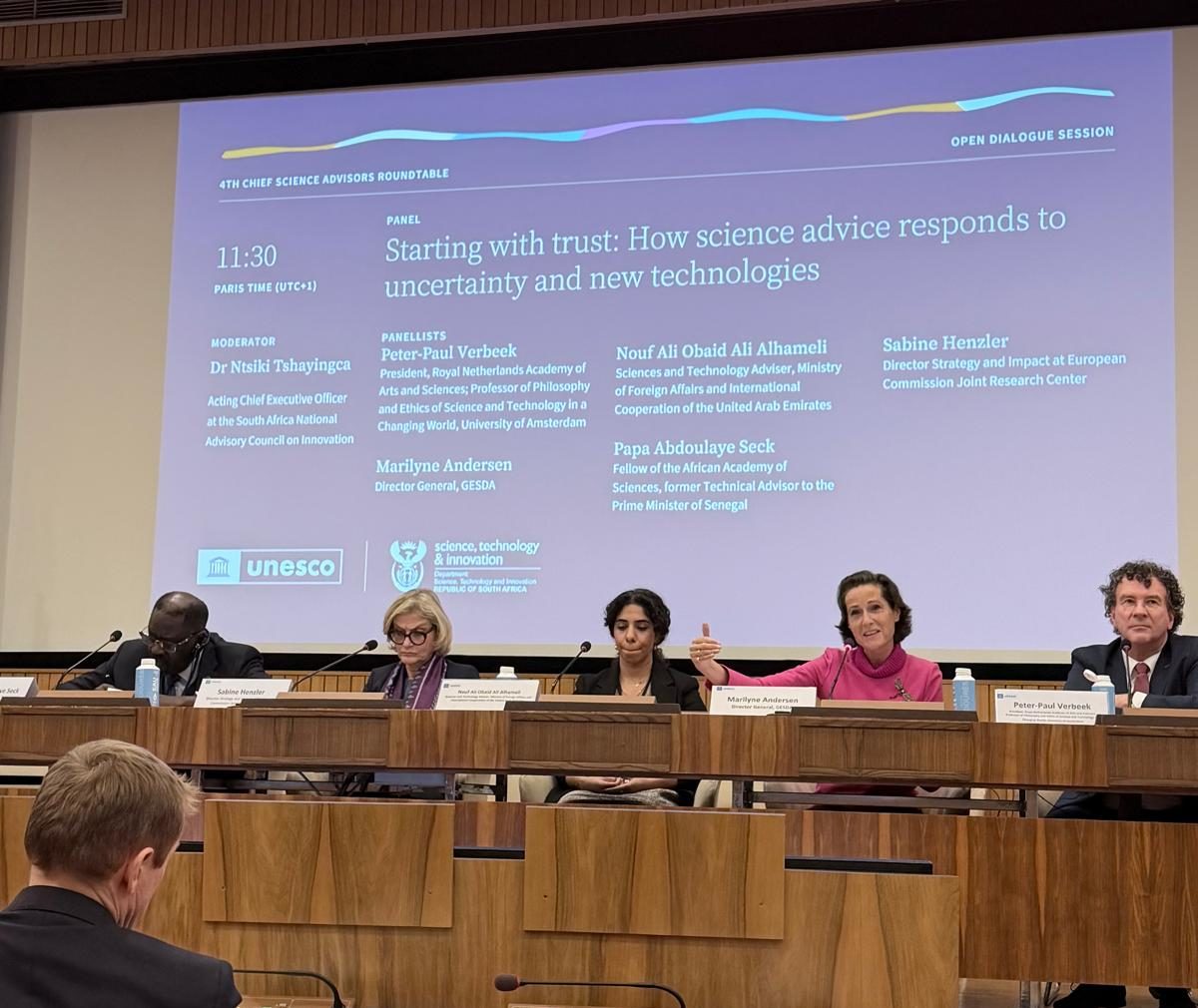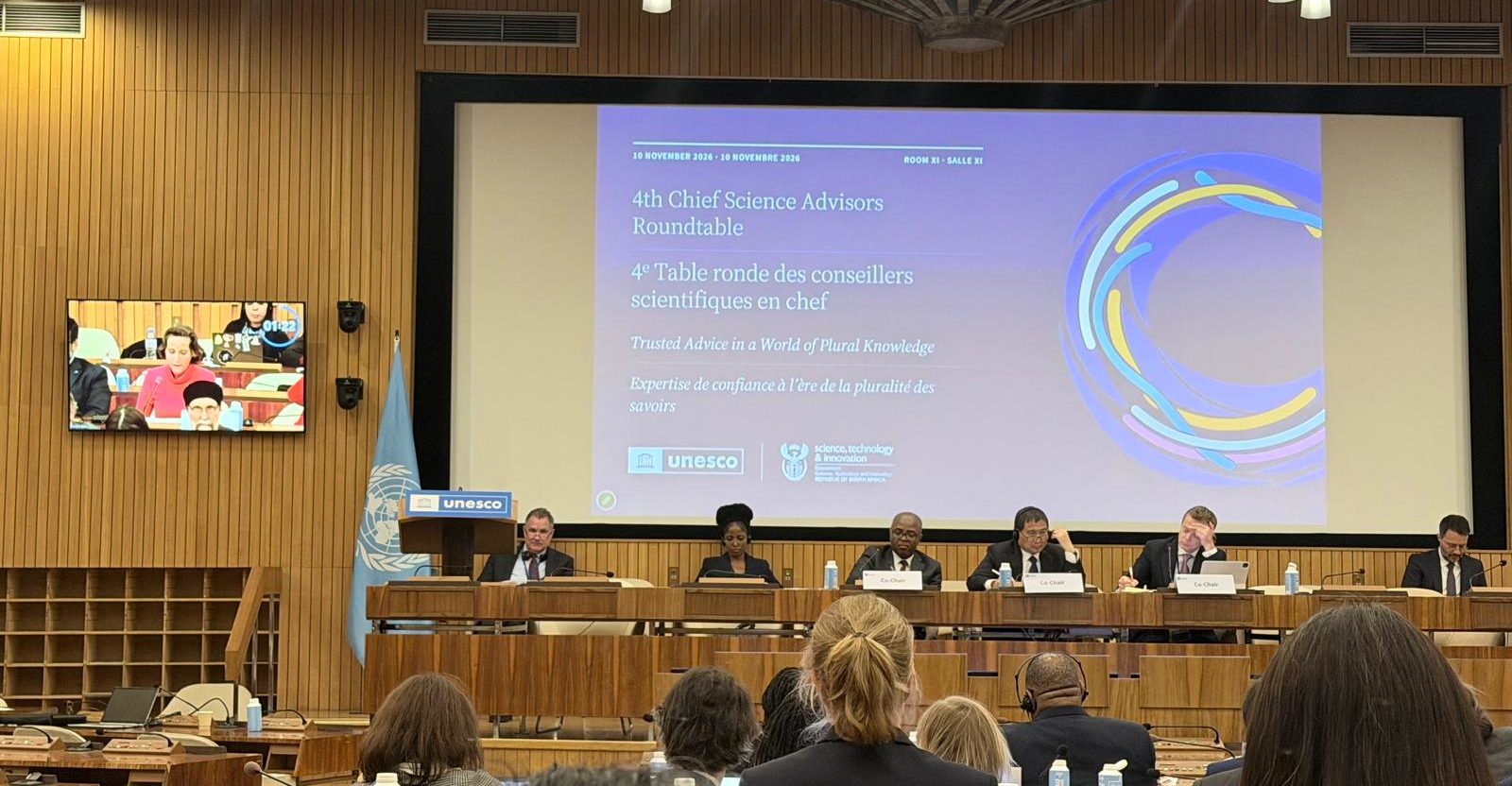
At the recent Chief Science Advisors Roundtable in Paris, GESDA’s Director General, Marilyne Andersen, emphasized that while the consequences of scientific advances remain uncertain, anticipation can help decision-makers act with confidence.
The Roundtable, organized by UNESCO and South Africa with the support of India, examined how public dialogue can clarify the trade-offs behind decisions and help build trust over time, a process that science anticipation can support by bringing forward possible futures and their implications.
Prof. Andersen highlighted that “good governance needs good timing. Rules that come too early stifle discovery; rules that come too late only repair damage. Anticipation helps find the right moment. It lets us ask what technology will become, and prepare standards, safeguards and partnerships before winners and losers are locked in.”
At an event hosted by the Permanent Delegation of Switzerland to UNESCO, Prof. Andersen spoke about the contribution of science diplomacy to the governance of artificial intelligence, stressing that science anticipation creates a window of opportunity which can be used to ensure that technological advances are accompanied by trust, responsibility and shared benefits.
Prof. Andersen also contributed to the “Anticipating Quantum x AI Convergence” event organised by UNESCO and India’s Office of the Principal Scientific Adviser (OPSA), which brought together experts from CERN, the OECD and governments to explore scientific opportunities, access and anticipatory governance. The event formed part of the ‘Road to Geneva 2027’ series of engagements by GESDA and OPSA, including GESDA’s contribution to the Technology Dialogue in Bengaluru in December 2026. On the margins, Prof. Andersen exchanged with Swiss State Secretary Martina Hirayama, and India’s Principal Scientific Adviser Prof. Ajay Kumar Sood, as part of wider Swiss–Indian dialogue on research and innovation.
On 9 November, UNESCO hosted the 10th anniversary symposium of the Foreign Ministries Science & Technology Advice Network, a global body of science advisors and diplomats working inside national Ministries of Foreign Affairs. GESDA’s Head of Global Engagement, Joanna Wiśniewska, spoke at the meeting, highlighting the benefits of introducing science anticipation into diplomacy, in order to strengthen the multilateral system and to sustain cooperation across geopolitical divides.