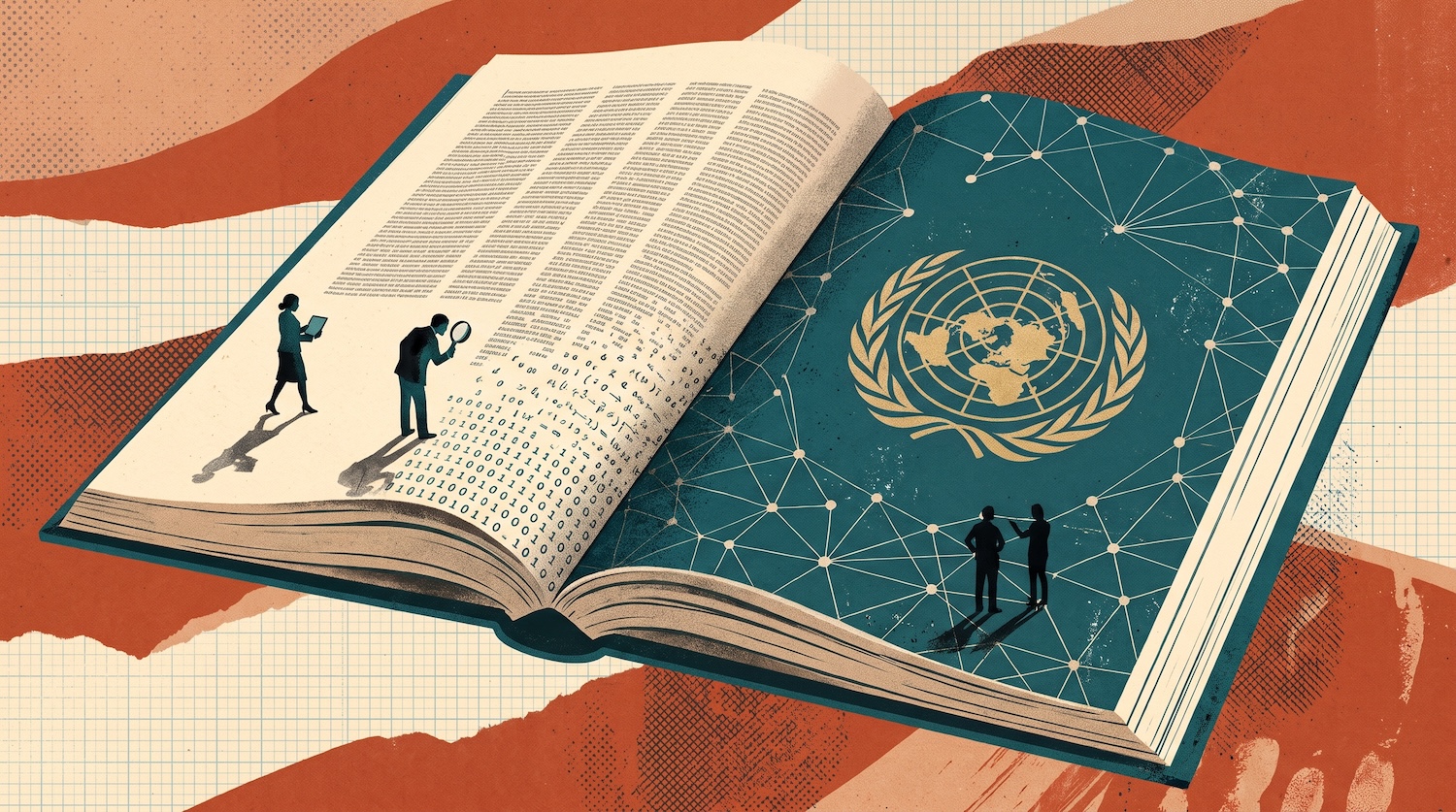
Data scientists are mining decades of UN resolutions in search of the hidden reasons why multilateralism succeeds or fails.
In the wake of the Arab Spring of 2010–11 and the key role played by social media, terms such as ‘data diplomacy’, ‘algorithmic diplomacy’ and ‘computational diplomacy’ entered the lexicon. Since then, one wave of digitisation after another, from big data to AI, has swept through society. Diplomacy has had to adapt, both in substance (these upheavals now shape geopolitical rivalries) and in form.
The underlying idea of computational diplomacy is simple: data science can help us understand, anticipate and perhaps even influence the course of international affairs. In short, it can serve as a foreign-policy tool. “More and more research is applying digital approaches to diplomacy,” says Didier Wernli, professor at the University of Geneva and member of the GESDA Anticipation Committee.
International organisations such as the United Nations sit on vast troves of data: tens of millions of pages of documents. Running them through algorithms could reveal long-term trends, helping today’s diplomats do their jobs more effectively. It might even help reform the institutions at the heart of a multilateral system widely described as being in crisis.
The UN as a complex system producing collective intelligence
Wernli uses computational methods to model how international organisations are governed. Such organisations can be seen as what scientists call ‘complex systems’. “That term means new properties emerge that are not always easy to predict,” says his colleague Roland Bouffanais, also a professor at the University of Geneva. “When a complex system is working well, it can display collective intelligence, like a murmuration of starlings. When it isn’t, the result can be deadlock, like a traffic jam.”
What if the inner workings of these systems could be modelled and quantified using the texts they produce? That is the question Wernli set out to answer in a 2023 study.
He has since moved on to practical applications. In a paper published that same year, he scrutinised the resolutions adopted by the World Health Assembly (WHA) between 1948 and 2022. “Resolutions mark the end of a decision-making process,” Wernli says. Officially described as the “formal expressions of the opinion or will of UN organs”, they mirror the diplomatic process in many ways.
Wernli and his colleagues then assessed how thoroughly the concept of ‘planetary health’ is embedded in global governance. The notion, which links public health with the health of the wider living world and the environment, has gained traction since the Covid-19 pandemic. The question they tried to answer is how far it has filtered into the day-to-day work of international institutions. They took a similar approach to map, through citations, the interactions of the UN’s General Assembly, Security Council and Economic and Social Council.
“You can think of the UN as a complex system that produces and perpetuates international norms,” says Bouffanais. “Their spread is a form of social contagion that can be studied through the texts the system generates, much like a trend propagates on social media.” To do this, the researchers turned to network analysis, examining how resolutions cite one another. The method is familiar in academia, where “citation networks between research papers create a system of shared norms within the scientific community,” Wernli says.
These ‘norms’ are principles, explicit or implicit, shared by member states. They include, for instance, the duty to fight world hunger or to tackle climate change. States abide by them out of a common interest in stability, reciprocity and predictability in international relations.
Natural language processing algorithms then helped identify recurring themes. “This enabled sentiment analysis [determining the opinion, judgement or emotion behind a given text]. Diplomatic language is highly measured, but it carries nuances that convey agreement or disagreement.” Tracking how these sentiment scores shift over time adds another layer, says Wernli. “We can connect them with the major items on the agenda, for example, to see which factors have helped reinforce them.”
Findings that complement diplomatic expertise
Some themes act as pillars of the citation network, says Wernli. “Human rights and the Sustainable Development Goals are cases in point: they have genuinely reshaped how the World Health Organisation (WHO) is governed.” At this stage, says Bouffanais, “the challenge is to identify the factors that make a norm more or less likely to spread.”
These findings shed light on the self-referential workings of international organisations. Albin Wagener, professor of discourse analysis and communication at the Catholic University of Lille, recently ran a statistical analysis of vocabulary use in the COP climate agreements between 2015 and 2022. “Before they say anything about the climate, these texts are primarily about themselves and the institutional machinery,” he says. “The language of these documents is closer to corporate communications, written less for outsiders than for insiders.”
In other words, turning texts into data is useful, but mainly for diplomats who already know the background to the negotiations. “What matters is not so much the final COP text as how it came about, through closed-door negotiations in which every word is fought over,” Wagener says. Bouffanais points to the COPs’ widely criticised decision-making rules, based on unanimity. “This may be an unwanted side effect of the UN system’s complexity. Computational diplomacy can help us work out whether, and how, these rules need to change.”
Identifying divisive issues
The analysis by Wernli and his colleagues also shows where the UN is most divided. For example, when they disagree, member states tend to reaffirm everything in previous resolutions, which shows up as an unusually high number of references to earlier resolutions. Infant nutrition, and breast-milk substitutes in particular, is a case in point. The WHO adopted an international code on the subject in 1981, yet the issue remains a recurring source of contention.
“States won’t necessarily adopt the same position, depending on the forum and their interests,” Wernli adds. “The positions reflected in resolutions on health, for example, are not always aligned with those on trade.”
Could this approach give rise to new tools for diplomats? “Many public health decisions are already driven by data, such as estimates of the economic burden of disease,” Wernli says. “We could have the same level of information about how the institution itself functions.” A specialist in global health diplomacy, who asked not to be named, says such tools could help level the playing field between countries with large negotiating teams and those without, or connect negotiations on trade, the environment and health that currently run separately.
Ultimately, computational diplomacy is an applied data science discipline. As such, it needs diplomats to be involved from the design stage, Wernli says. “Our studies aim to put data science into practice and to create spaces for dialogue between diplomats and data specialists.” Diplomats, for their part, need to learn to think in terms of data. “More of them need to be trained to make use of the data that approaches such as ours can provide. That is the thinking behind the new bachelor’s programme in Computational Sciences and International Relations at the University of Geneva.”
Computational diplomacy: a long-term bet?
Training Swiss diplomats alone will not be enough to improve international negotiations, says Wernli. Their counterparts from all over the world will need to reach the same level of data literacy. Computational diplomacy, to be truly useful, cannot be the project of a single laboratory or a single country. “At the moment, we are a coalition of the willing. We need states to lead the way.”
Wernli calls for digital infrastructure designed specifically for computational diplomacy. “Access to computing power is already very unevenly distributed, and the recent advances in generative AI have only widened that gap.” AI could also help make these findings accessible. “A large language model specifically trained on multilateral texts could help. Perhaps one day it will even be possible to create a simulation tool to optimise decisions.”
Before then, the field faces more mundane hurdles. “One current limitation is optical character recognition [software that turns scanned pages into machine-readable text],” he says. AI is only as reliable as the data it is fed.
With multilateral institutions under mounting scrutiny, data science can hold up a mirror to how they work. From the UN’s UN80 initiative (to which SiDLab has been invited to contribute) to the Security Council and the WHO, reform is in the air.
“Today, the mechanisms that allow norms to spread within the UN no longer work as well as they once did, perhaps because some states are no longer playing by the rules of multilateralism,” says Bouffanais. Sweeping reform looks increasingly unavoidable, but he urges caution: “In trying to improve the system, we could inadvertently make it more complex still and trigger new, unforeseen side effects.” Computational diplomacy could help foresee these pitfalls, for example through a common framework that lets data flow across the whole UN system, concludes Wernli.
By
Sarah Sermondadaz, journalist
With
Didier Wernli, professor at the Global Studies Institute (GSI),
University of Geneva (Switzerland) and member of the GESDA Anticipation Committee.
Roland Bouffanais, professor at the Global Studies Institute (GSI),
University of Geneva (Switzerland) and member of the GESDA Anticipation Committee.
Albin Wagener, professor of communication at the Catholic University of Lille (France)