Series – Stateless territories 1/7. The abyss is so difficult to reach that deep-sea science advances at a very slow pace. Our economic appetites move far more quickly, threatening the international treaties meant to protect them.
In January of this year, Japan embarked on the experimental mining of a seabed off the island of Minamitorishima, within its national waters. A research vessel chartered by the government extracted sediment from the deep. Those muds, thought to be rich in rare earth elements, lay at a depth of more than 6,000 metres. It was a technical feat, made possible by a powerful pumping system – for the sediments sit not merely in the abyss but buried beneath a thick layer of deposits. In its official communiqué, Japan hailed it as a “world first”.
At the time of writing, the rare-earth content of the samples remains unknown. The agency was careful not to get ahead of itself, stressing that the priority had been to establish operational feasibility. Even so, should the results prove positive, it envisions extracting hundreds of tonnes of material per day as early as 2027. Concerned about its dependence on China for the strategic minerals that underpin its electronics industry, Tokyo is looking for an escape route on the ocean floor.
Japan’s initiative is part of a global trend. Over the past five years, interest in deep-sea resources has intensified. Several countries, among them Norway and the Cook Islands, have considered similar ventures. But the United States, under the Trump administration, has plunged into the race for strategic minerals with the greatest energy – on land, through pressure on Ukraine and territorial claims over Greenland, and on the seabed, where reconnaissance projects are already under way. In March of this year, the National Oceanic and Atmospheric Administration (NOAA) launched a $20 million exploration programme in the waters of American Samoa.
Behind this campaign lies an executive order signed in April 2025 by the US president: “Unleashing America’s Offshore Critical Minerals and Resources.” The text pursues, much like Japanese policy, the same goal of strategic independence. “These resources are key to strengthening our economy, securing our energy future and reducing our dependence on foreign suppliers of critical minerals”, it states.
But the American initiative does not stop at territorial waters. The most contentious provision of the order – which is not short of controversial elements – concerns the granting of exploration and exploitation licences in international waters. Washington is not among the 172 countries party to the International Seabed Authority (ISA), the body charged with regulating mining activities beyond the limits of national jurisdiction. Within a week of the order’s signing, the American subsidiary of Canadian firm The Metals Company filed the first application.
The company was seeking a permit to explore and extract resources from the Clarion-Clipperton Zone – an oceanic plain between Hawaii and Mexico. This area falls squarely under the jurisdiction of the ISA. By introducing a competing regulatory regime, the White House might undermine the international consensus that governs the high seas.
The international framework for deep-sea mining faces the threat of fracture. Fortunately, new areas of agreement are also emerging – notably through the entry into force, last January, of the High Seas Treaty. Meanwhile, scientists press on with their patient work of exploring the ocean’s depths, characterising their unique fauna and flora and collecting genetic material. Their findings are reshaping the terms of debate all the way to the United Nations.
Polymetallic nodules: objects of desire
Stretching across more than four million square kilometres of the central Pacific, the Clarion-Clipperton Zone is, for the most part, carpeted in peculiar objects: strange geological formations, unremarkable in appearance, roughly the shape and size of a charred potato. These are the primary targets of our covetousness. Known as polymetallic nodules, these aggregates of metals and minerals are estimated to cover around 38 million square kilometres of ocean floor worldwide, according to a 2016 study published in Marine Policy by a German team. That surface area is nearly 25% larger than the African continent. The total mass of these objects remains the subject of speculation, although one estimate puts it at 500 billion tonnes.
These nodules contain four metals of strategic importance: cobalt, nickel, copper and manganese. Cobalt is a key component of lithium-ion batteries and, together with nickel, an indispensable ingredient in numerous aerospace applications. The cobalt market is at the mercy of erratic production in its principal extraction sites, in the Democratic Republic of Congo. Some see nodule mining as a way to stabilise this fragile supply chain.
Yet nodules are far from renewable resources, despite their abundance. They are an essential pillar of deep-sea ecosystems, and they take millions of years to form. “Their formation unfolds on a geological timescale. When you remove a nodule from a mining site, you remove a habitat, its associated biodiversity and all its ecological functions, for millions of years,” says Sabine Gollner, a deep-sea biologist at the Royal Netherlands Institute for Sea Research and a member of the GESDA Expert Panel.
Just last year, a study published in Nature provided, for the first time, an estimate of long-term environmental damage. After a prototype mining device was deployed in 1979 at a depth of 5,000 metres in the Clarion-Clipperton Zone, scientists from the National Oceanography Centre in the United Kingdom took stock of the ecological impact nearly 44 years later. The track, around eight metres wide, had not recovered at all in almost half a century.
Among the chief victims of the scraping were the many deep-sea invertebrates that spend their lives fixed to the seabed – sponges, corals and crinoids. Without nodules – the only solid substrate in an otherwise muddy environment – they have nothing to cling to. Another paper, published in 2020 in Science Advances by a German team, examined the microbial fauna 26 years after another mining experiment in the South Pacific. “After all that time, even the microbial functions of the environment remain disrupted,” says Gollner. “That gives you a sense of how slow recovery is.”
Oceanography: a science that advances drop by drop
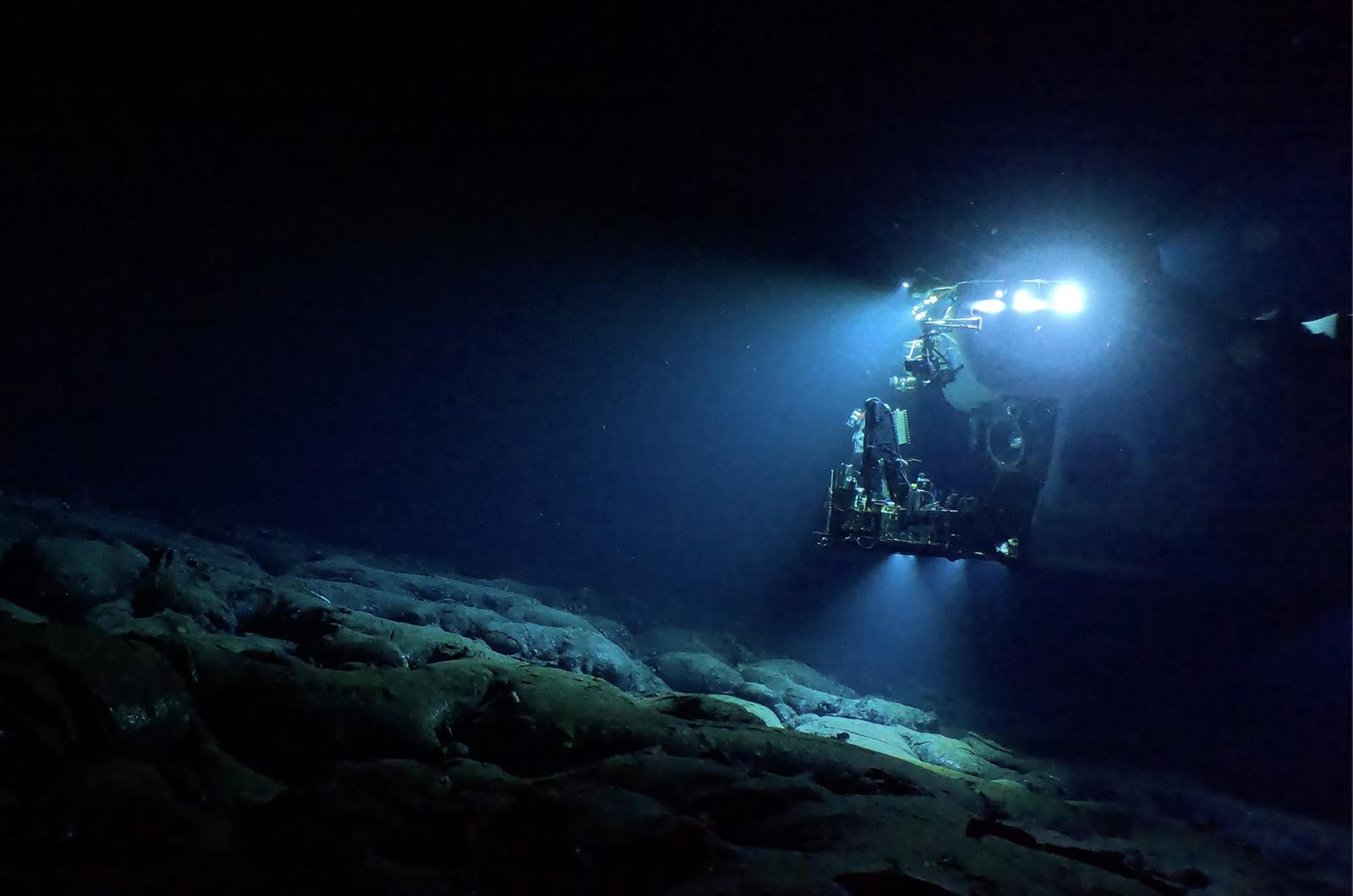
These findings are all the more troubling given that our knowledge of deep-sea ecosystems is, at best, patchy. How, then, can we begin to assess the impact of mining operations? Up against severe technical constraints, oceanography delivers answers in dribs and drabs. “On land, everything is mapped by satellite, with a click on Google and you can see where the plains, forests and pastures are. On the ocean floor, we depend on robotic submersibles, and it is so dark that your field of vision is limited to the narrow beam of your light,” says Gollner.
The cost of expeditions also represents a major obstacle to scientific progress, she adds. “We are talking about vessels capable of operating on the high seas, with a minimum of around thirty people on board. Roughly half are typically crew running the ship, while the other half are scientists. And if you have a larger vessel, say 60 to 80 people including crew, with a robotic submersible on board, you are probably looking at costs of around 50,000 euros per day.”
If the deep sea remains largely unknown, one thing is certain: it is far – very far – from the sterile desert that much of the public still imagines. In 1960, when Jacques Piccard’s bathyscaphe Trieste reached the bottom of the Mariana Trench, at a depth of roughly 10,990 metres, many scientists expected to find no life capable of withstanding such extremes of pressure and temperature, even more so in total darkness. Since then, virtually every descent into the abyss has yielded new species.
“Over the past five years, in the Clarion-Clipperton Zone alone, we have discovered around 5,000 new deep-sea species,” says Gollner. “I’m only talking about animals. If you were to count the microorganisms as well, there would be many, many more.” Deep-sea research in the Clarion-Clipperton Zone may be advancing at a rate of three newly described species per day, but most of them stand little chance of appearing again in the beam of a robotic submersible any time soon. Unable to study them closely, scientists can rarely do more than speculate about their biology and ecological role.
Could we lay waste to this world before we have even taken the time to understand it? Could we rob humanity forever of the medical and industrial potential locked in this unique and enormous genetic repository, rivaling that of the tropical rainforests? A study published last year in Science Advances states that we have visually surveyed only 0.001% of the deep ocean floor, barely one-tenth the surface area of Belgium. At this rate, and in the face of mounting political and economic pressures – industrial demand, geopolitical tensions, the decoupling of global economies – our will to proceed with industrial extraction may outpace the slow progress of scientific investigation. With losses and damage that we may never be able to assess.
A high-risk political fracture
The risks of premature or irresponsible exploitation are all the greater because the international safeguard – the ISA – is seeing its authority contested, for now by the United States. Among the handful of countries that are not party to the organisation, the US is the only one with the technical capacity to mine the seabed, says Sam Robinson, a historian of science and technology at the University of York.
“The United States, France, the United Kingdom and Japan are the only countries with the required technology. The Global South risks getting none of the benefits and having no say, because those countries are not technologically advanced enough, and because there is no real mechanism for them to file a complaint,” he warns. Through its unilateral actions, Washington risks undermining the equity goals that the ISA pursues in the name of the common heritage of mankind – the principle under which the deep seabed is held.
That same notion of a universal common heritage was at the center of the official statement from the Secretary-General of the ISA, Leticia Reis de Carvalho, issued shortly after Donald Trump signed his executive order on seabed mining: “This [order] can only refer to resources located on the seabed and ocean floor of the United States, since everything else is the common heritage of mankind (…). No State has the right to unilaterally exploit the mineral resources of the Area outside the legal framework established by the United Nations Convention on the Law of the Sea.”
Among ISA member states, the prevailing position is that the Authority’s own guidelines must be finalised before nodule exploitation in international waters can proceed. Those guidelines are to be grounded in a scientific assessment of environmental impact and must meet criteria of equity. So far, the organisation has issued just 31 exploration licences to around 20 companies and organisations. These licences are strictly limited to prospecting, technology testing and financial assessments.
Washington, by contrast, intends to issue full exploitation licences. No permits have yet been granted, but The Metals Company’s application has been moving forward since it was filed last year. In March 2026, the company announced that it had received a status of “substantial compliance” with American law from NOAA. Several further steps remain, however, before a license can be granted, including an environmental compliance assessment.
What happens if the United States issues deep-sea mining permits in international waters while the ISA still only authorises exploration? When submitting its permit application to Washington, The Metals Company repeatedly attacked the ISA in bluntly worded statements, questioning its authority, accusing it of “bad faith” and even claiming it was being held hostage by NGOs. Will other private companies follow suit, rushing to the United States to open subsidiaries or relocate their operations?
A standoff has begun. In Yale Environment 360, the journal of Yale University’s School of the Environment, Jeff Watters, Vice President for External Affairs at the Ocean Conservancy, voiced his concerns: “A decision to unilaterally embark on deep-sea mining runs counter to the way we as a global community have been cooperatively working on the high seas for decades now. Unilateral action to pursue deep-sea mining opens up a whole Pandora’s box of questions in terms of conflict on the high seas, conflict between nations, and whether or not this is an extractive industry that we even need.”
Considered since the 1970s and long dismissed as too marginal to be worth the cost, the mining of polymetallic nodules could yet become a reality, driven by the combined pressures of growing industrial demand and the current geopolitical climate. But nodules are not the only resource coveted in international waters. In the next episode of our series on the world’s stateless spaces, we turn to marine genetic resources, a pillar of the High Seas Treaty that recently entered into force.
By
Lionel Pousaz, GESDA Editor-in-Chief
Featuring
Sabine Gollner, deep-sea biologist at the Royal Netherlands Institute for Sea Research
and member of the GESDA Expert Panel (Netherlands)
Sam Robinson, historian of science and technology at the University of York (United Kingdom)