March 16, 2026
Neurotechnology is beginning to move from research laboratories into real-world applications faster than many institutions are prepared to manage. Advances in brain-computer interfaces, neural data analysis, and neuro-AI systems expand the ability to record, interpret, and potentially influence human brain activity.
That question is now entering international policy discussions. Recent discussions at the United Nations Human Rights Council in Geneva reflect this shift, as governments and experts begin examining how technologies capable of accessing neural signals intersect with human rights, privacy, and personal autonomy. As with artificial intelligence, the challenge is no longer anticipating that neurotechnology will reshape society — but ensuring institutions are prepared before it does.
The 2026 GESDA Science Breakthrough Radar® identifies brain-computer interfaces, cognitive enhancement, and neuro-AI integration as among the scientific developments most likely to test existing governance frameworks. The Radar cites market growth as a driver of rapid uptake, noting forecasts that the neurotech devices market could reach over $24 billion by 2027.
While many applications remain in the early stages, the pace of research suggests institutions will soon face decisions about how such technologies should be governed. In the case of neurotechnology, however, the widening gap between scientific capability and institutional readiness may become particularly sensitive because the technologies interact directly with human cognition. As applications expand beyond medicine, the issues will likely become more prominent.
Neurotechnology moves from research to Geneva’s policy arenas
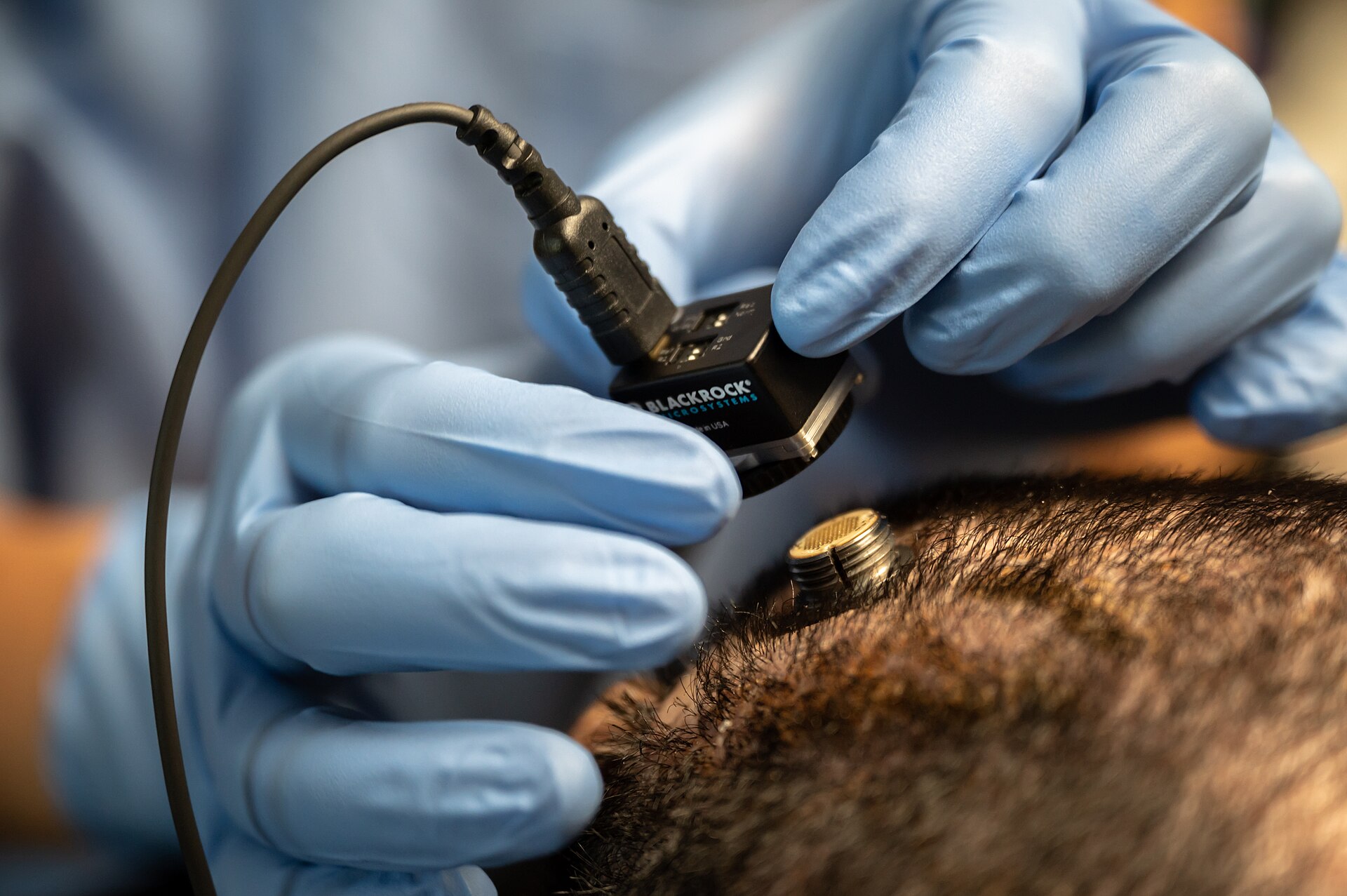
Until recently, most neurotechnology research focused on medical applications. Now, brain-computer interfaces enable patients with paralysis to communicate through neural signals, while neural stimulation techniques show promise in treating neurological disorders such as Parkinson’s disease and epilepsy. All demonstrate the potential of direct brain-machine communication.
At the same time, advances in machine learning and neural data processing expand the capabilities of these technologies beyond clinical contexts. New systems are able to decode patterns of brain activity with increasing precision, opening possibilities for applications in rehabilitation, cognitive assistance, and human-machine interaction.
As these capabilities expand, policymakers are beginning to examine the broader implications. Discussions at the United Nations Human Rights Council in Geneva have begun this month to explore precisely how technologies capable of accessing neural signals may intersect with existing legal protections, including the rights to privacy, dignity, and freedom of thought.
Earlier this week, the 47-nation council called on UN member nations to provide input for the UN secretary-general’s report to the General Assembly on “the latest developments, challenges and good practices in human rights in the administration of justice, including, inter alia, on the latest developments, risks and required safeguards regarding the potential use of neurotechnology and other emerging technologies in the administration of justice, and on the activities” within the UN system.
Rather than proposing entirely new legal regimes, early debates are focused on how established human rights principles might apply in the context of emerging neurotechnologies. A council resolution last year that called for drafting new guidelines emphasized “the importance of applying the existing human rights framework to address the challenges and realize the opportunities of neurotechnologies, while noting that these technologies may lack adequate regulation.” This reflects a broader pattern in technology governance, where institutions adapt existing frameworks before developing new ones.
Not only within the Human Rights Council but across Geneva’s institutions, the issues have increasingly become a focal point for discussions linking science and governance. International organizations, diplomatic missions, and research institutions regularly convene experts and policymakers to examine how emerging technologies intersect with global governance frameworks.
While these conversations remain exploratory, they signal a growing recognition that emerging neurotechnologies may require coordinated international attention. The intersection of neuroscience, AI, and data governance creates a complex policy landscape across multiple regulatory domains. As with earlier technological transitions, coordination is likely to develop through dialogue, standards, and evolving institutional practices rather than through a single comprehensive treaty or agreement.
“The time is ripe for reflecting on concrete legal strategies to ensure that human rights are respected and protected in practice amid neurotechnological advancement, so that the benefits of these emerging technologies can be realized without eroding human dignity and fundamental rights,” said Timo Istace, an associate researcher at the Geneva Academy of International Humanitarian Law and Human Rights. In January, Istace and Sjors Ligthart, an associate professor at Tilburg University, published guiding principles for anticipating human rights risks in neurotechnology as part of a continuing research project.
The governance challenge ahead
Neurotechnology develops across a highly distributed ecosystem. Universities, medical researchers, technology companies, and startups all contribute to advances in neural sensing, machine learning, and brain-machine interfaces. Public research institutions and private companies often operate within different regulatory environments and innovation incentives.
This increases both the pace of innovation and complexity of governance. Technologies developed for therapeutic purposes may eventually find commercial applications, while advances in AI may unlock new ways to interpret neural data. As capabilities evolve, institutions will need to look beyond technical regulation. Who should control access to neural data? How should societies protect mental privacy? What safeguards are needed to ensure that neurotechnology is used responsibly?
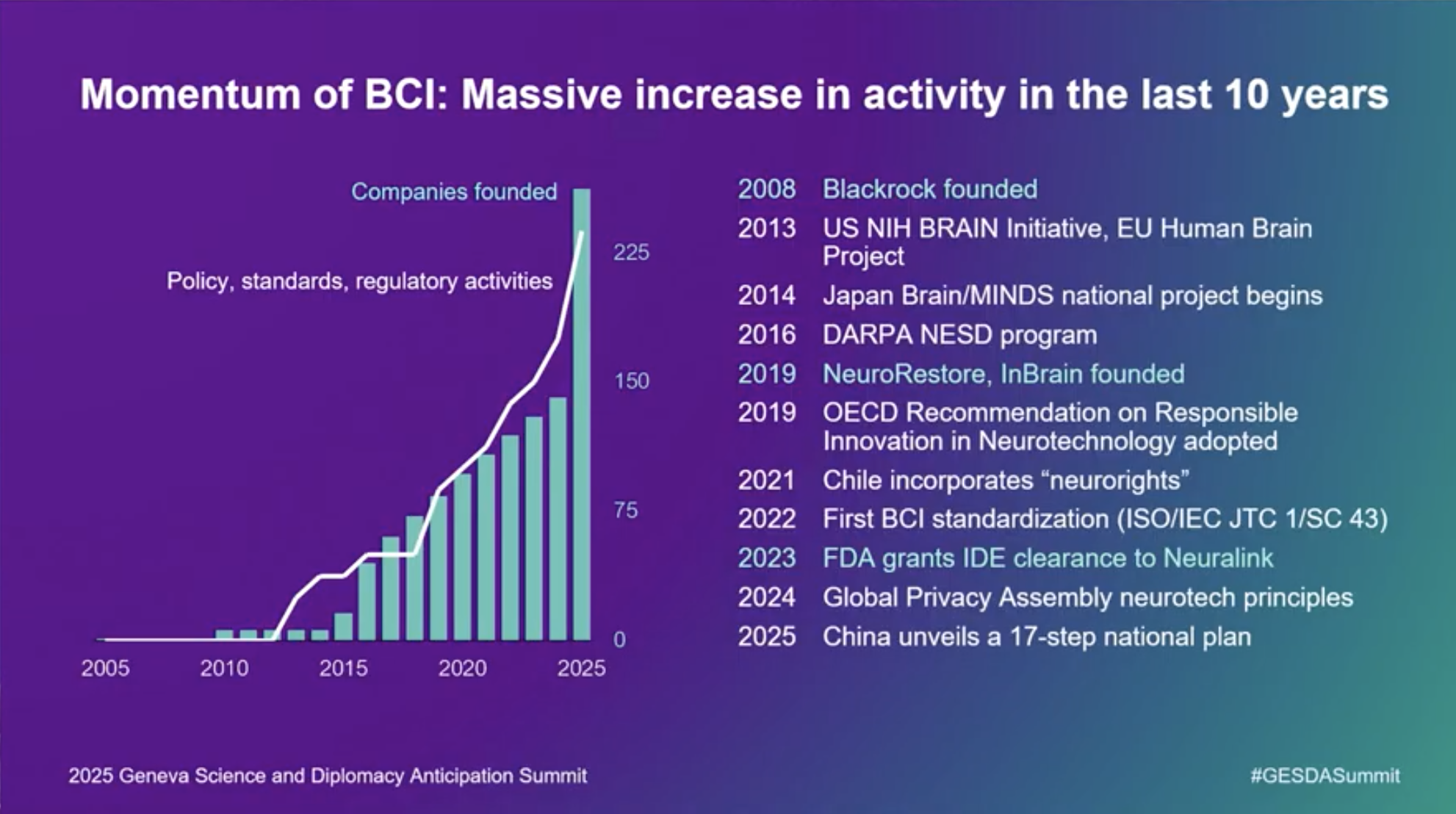
These questions are likely to become more prominent as investment and research accelerate. Neurotechnology is expected to move from specialized research toward broader technological ecosystems. Advances in neuroscience, engineering, and AI will continue to expand the range of possible applications, from medicine to human-machine interaction.
Patrick Aebischer, the vice chairman of GESDA, told the 2025 GESDA Summit that GESDA has closely followed the development of brain-computer interface technology and will begin taking a more formal approach toward creating an ethical framework for its development. “This field has moved quite a bit,” Aebischer said. “Why has this happened? For two reasons. One is the technology allows you to acquire more data,” he added. “And, let’s say, the AI having an impact on trying to understand this amount of data — so as to make something useful out of it, and one of them being the targeted BCI.”
Where the science and diplomacy can lead us
The 2026 GESDA Science Breakthrough Radar®, distilling the insights of 2,390 leading researchers from 89 countries, warns that while many countries regulate data collected by these technologies, consumer brain‑data devices may fall outside current regulation. It calls for a global ethical consensus to balance frontier scientific pursuit with societal needs.
Key Radar references:
→2.1 Cognitive Enhancement — Scientific advances may enable technologies capable of augmenting human cognitive capabilities, raising questions about access, fairness, and governance.
→2.4 Future of Consciousness — Advances in neuroscience may deepen understanding of consciousness and cognition, potentially enabling new forms of monitoring and intervention.
→Invited Contribution: The Challenges of Urban Neurotechnology — Devices such as brain-computer interfaces and neural sensors create an ecosystem that senses and responds at the cognitive level. This urbanization of neurotechnology marks a profound yet still under-explored sociotechnical transformation.